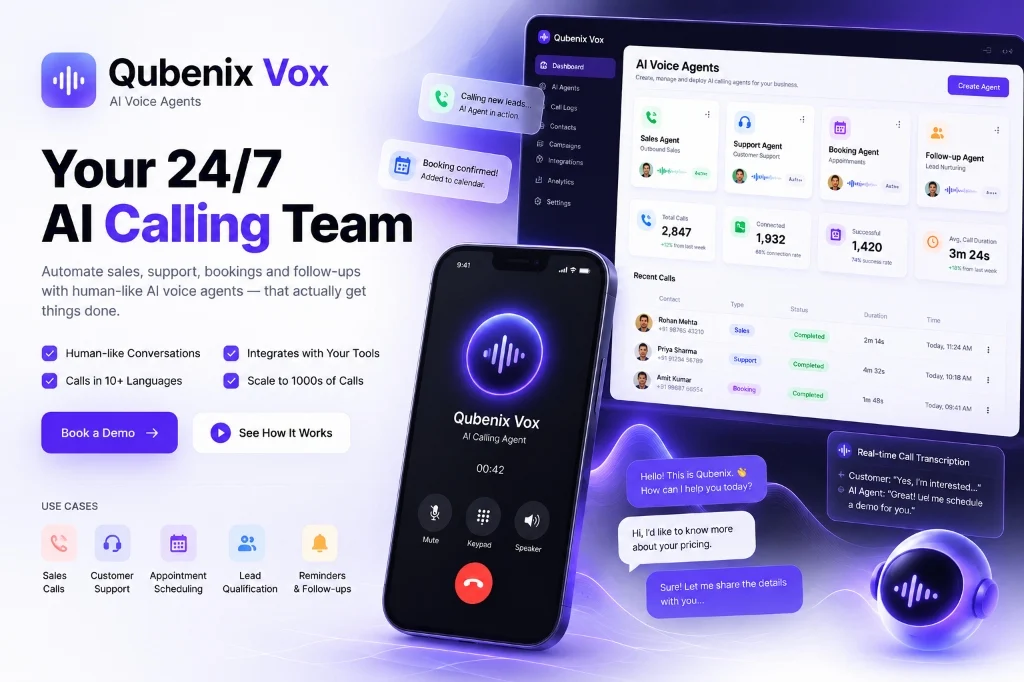
- The end of rigid IVR: Modern AI voice agents replace clunky "press 1 for sales" phone trees with natural, conversational spoken dialogue that understands context and accents.
- Sub-second latency threshold: For a phone call to feel natural, round-trip latency (Speech-to-Text → LLM inference → Text-to-Speech) must remain under 800 milliseconds.
- Cost structure: Fully integrated voice AI costs approximately $0.07 to $0.12 per minute, representing an 80%+ operational cost reduction compared to offshore call centers.
- Strict compliance: Commercial calling requires adherence to regulatory standards: caller identification, clear recording disclosure, and instant opt-out handling.
For decades, enterprise phone support has been defined by customer frustration: navigating robotic Interactive Voice Response (IVR) menus, enduring long hold queues, and repeating account details across multiple human representatives. At the same time, maintaining 24/7 human phone centers represents one of the largest operational line items for growing companies.
Recent breakthroughs in streaming speech recognition, fast inference language models, and expressive neural speech synthesis have made true Conversational AI Voice Agents viable. Businesses can now deploy voice assistants that answer instantly, understand complex spoken instructions, query back-office systems in real time, and politely escalate to human supervisors when necessary.
1. The Four-Stage Technical Architecture of Voice AI
Unlike text chatbots where users tolerate 3 to 5 seconds of typing latency, human spoken conversations stall if pauses exceed 800 milliseconds. Building a successful voice agent requires an ultra-low-latency streaming pipeline:
- Telephony & WebRTC Layer: Manages SIP trunking and VoIP audio packet streams via carriers (e.g., Twilio, Plivo, Telnyx). Bi-directional audio is streamed continuously in 20ms chunks.
- Streaming Speech-to-Text (STT): Converts incoming caller audio to text in real time using models optimized for conversational cadence (e.g., Deepgram Nova-2). Crucially, the STT layer must detect Voice Activity (VAD) to know when the user has stopped speaking or interrupted the agent.
- Streaming LLM Inference: Fast foundation models (e.g., Claude 3.5 Haiku, GPT-4o-mini) process the transcript tokens as they arrive. Using structured function calling, the model can query the CRM or calendar database while simultaneously generating verbal tokens.
- Neural Text-to-Speech (TTS): High-fidelity neural voice engines (e.g., ElevenLabs, Cartesia, PlayHT) synthesize spoken audio from the first few returned tokens, streaming audio back to the caller before the full sentence is even generated.
2. High-ROI Business Use Cases for AI Voice Calling
A. 24/7 Inbound Triage and Service Dispatch
For home services, emergency repair providers, healthcare clinics, and logistics companies, missed calls mean lost revenue. Voice agents answer within two rings, gather emergency details, locate the nearest on-call technician, and dispatch immediate assistance or schedule a morning callback.
B. Appointment Scheduling and Calendar Modification
Dental practices, salons, and professional advisory firms automate thousands of booking calls monthly. The voice agent negotiates dates, checks real-time doctor availability via Google Calendar or custom APIs, sends an instant SMS confirmation, and handles rescheduling requests without human intervention.
C. Outbound Appointment Confirmations and Lead Reactivation
High-volume sales teams use outbound voice agents to confirm attendance for upcoming webinars or verify interest from dormant leads. Because the agent speaks naturally, it can answer preliminary qualification questions and seamlessly transfer interested prospects directly to a live sales executive.
3. Financial Breakdown: The Real Cost Per Minute
| Pipeline Component | Typical Provider | Cost per Minute |
|---|---|---|
| Telephony (Inbound / Outbound) | Twilio / Plivo / Telnyx | ~$0.012 – $0.022 / min |
| Streaming Transcription (STT) | Deepgram Nova-2 | ~$0.004 – $0.007 / min |
| LLM Inference (Prompt + Output) | Fast Streaming Models (Claude/GPT-4o-mini) | ~$0.015 – $0.030 / min |
| Neural Voice Synthesis (TTS) | ElevenLabs / Cartesia / Azure Neural | ~$0.035 – $0.060 / min |
| Total Infrastructure Cost | End-to-end pipeline | ~$0.07 – $0.12 / minute |
Compared to fully burdened human agent rates ($15 to $35/hour in Western markets, or $5 to $10/hour in offshore centers), voice AI provides radical cost efficiency while eliminating hold times during peak call volumes.
4. Regulatory Compliance and Ethical Telephony
Operating automated voice telephony requires strict compliance with international telecommunications frameworks:
- Clear AI Identity Disclosure: Always inform the caller at the beginning of the interaction: "Hi, I'm the automated virtual assistant for [Company Name]."
- Call Recording Notice: If audio is recorded for quality or training, state: "This call may be recorded for quality assurance."
- Immediate Do-Not-Call (DNC) Compliance: If an outbound recipient states "Take me off your list," the agent must recognize the intent, confirm removal immediately, and automatically register the number in your DNC suppression table.
- Compliance with National Calling Hours: Outbound calling must strictly adhere to statutory calling hours (e.g., 9:00 AM to 8:00 PM local time).
5. Managing Edge Cases: Interruptions and Human Handoffs
The difference between an amateur voice bot and a production-grade voice agent lies in how it handles conversational edge cases:
Finally, every business voice agent must include an explicit Human Escalation Gateway. If a customer displays high sentiment frustration, expresses an unfamiliar legal question, or asks for a human twice, the agent states: "Let me transfer you immediately to one of our customer specialists," executing a SIP transfer to an available team member along with a live transcript summary.
Frequently Asked Questions
How fast do AI voice agents respond during phone conversations?
Modern conversational voice agents achieve total round-trip latency of 450ms to 800ms using streaming speech-to-text, fast inference LLMs (such as Claude 3.5 Haiku or GPT-4o-mini), and WebRTC audio streaming, matching natural human conversational cadence.
What is the typical per-minute cost of an AI voice agent?
The combined infrastructure cost—including telephony carriers (Twilio/Plivo at ~$0.015/min), transcription (Deepgram at ~$0.005/min), LLM tokens (~$0.015/min), and neural voice synthesis (ElevenLabs/Cartesia at ~$0.035/min)—averages between $0.07 and $0.12 per conversation minute.
Are AI voice calls legal and compliant with calling regulations?
Yes, provided the system complies with telecommunications laws (such as TRAI regulations in India, TCPA in the US, and GDPR in Europe). Best practices require explicit disclosure that the caller is an AI assistant, immediate compliance with opt-out requests, and secure handling of call audio recordings.
Deploy Intelligent AI Voice Telephony with Qubenix Vox
Qubenix engineers custom voice agents with sub-second latency, natural accents, calendar booking, and seamless CRM integrations.
Explore Qubenix Voice SolutionsReferences & Standards
- Telecom Regulatory Authority of India (TRAI): "Guidelines for Commercial Communications and Customer Preference Regulations."
- US Federal Communications Commission (FCC): "Declaratory Ruling on AI Technologies in Telemarketing and TCPA Compliance."
- IETF RFC 3261: "SIP: Session Initiation Protocol Specifications for Real-Time Telephony."