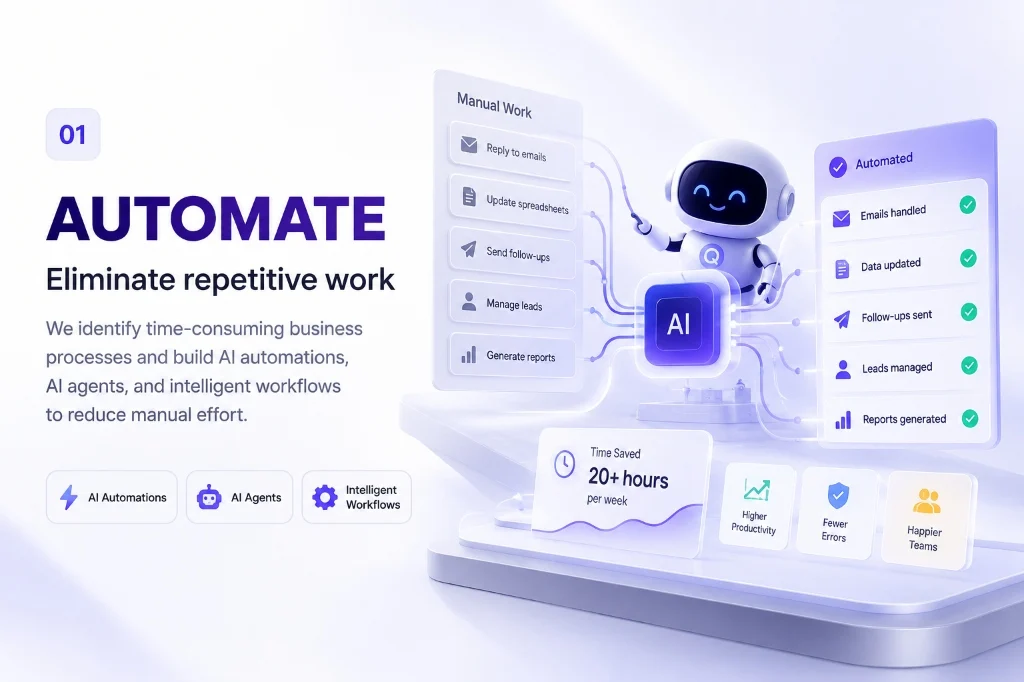
- Automate before expanding headcount: Small businesses gain the highest ROI by automating high-frequency, low-variance administrative tasks before hiring additional coordinators.
- Combine rules with intelligence: Pure LLMs are prone to hallucination; the strongest architectures use deterministic workflow engines (such as n8n) for logic and AI only for unstructured data tasks.
- Prioritize lead speed: Responding to inbound leads within 5 minutes via automated AI qualification can increase qualification rates by over 300%.
- Maintain human-in-the-loop safeguards: Financial transactions, contract approvals, and sensitive customer escalations must always preserve explicit human review thresholds.
For small and medium-sized businesses (SMBs), growth rarely stalls due to a lack of market demand. More frequently, businesses hit an operational ceiling: founders and key staff spend 40% to 60% of their working hours copying data between spreadsheets, chasing invoices, drafting repetitive customer emails, and manually updating CRM records.
While enterprise corporations spend millions on bespoke software departments, small businesses can now achieve comparable operational leverage using modern AI automation workflows. This guide covers the practical architectures, proven use cases, real-world costs, and common pitfalls of implementing AI automation in a growing enterprise.
1. The Operational Reality: Why Small Businesses Automate
Traditional small business operations rely heavily on manual glue. When a lead submits a website form, someone manually reads the submission, checks staff calendars, writes an email, creates a contact in the CRM, and alerts the sales team on WhatsApp or Slack. When a vendor sends a PDF invoice, an administrator manually re-types numbers into accounting software.
This approach has three structural flaws:
- Linear Cost Scaling: Every 20% increase in order or inquiry volume requires hiring more operational staff, diluting operating margins.
- Human Latency: Leads that sit untouched overnight or over weekends experience a steep drop-off in conversion.
- Data Fragmentation: Manual data entry introduces discrepancies between accounting, inventory, and customer databases, obscuring business intelligence.
By connecting existing software tools into unified, event-driven automated workflows, businesses break this linear scaling curve and establish reliable 24/7 operating procedures.
2. Top 5 High-Impact AI Automation Use Cases for SMBs
A. Instant Inbound Lead Triage & Qualification
When an inquiry lands via your contact form or messaging channel, an AI agent instantly analyzes the query against predefined qualification criteria (e.g., budget, company size, service requirement). The agent can:
- Normalize the lead information and create or update a profile in your CRM system.
- Enrich company details via public registries or APIs.
- Draft a contextual, personalized reply addressing the customer’s specific requirements.
- Notify the designated account manager with a concise dossier and scheduling link.
B. Automated Invoice & Receipt Processing
Instead of manual bookkeeping data entry, computer vision models and structured document LLMs extract vendor names, invoice numbers, line items, tax IDs, and totals from incoming email attachments. The automation verifies totals against purchase orders and synchronizes the transaction directly with systems like QuickBooks, Xero, or custom databases.
C. Omnichannel Customer Support Drafting
Rather than relying on clunky, frustrating decision-tree bots, businesses deploy Retrieval-Augmented Generation (RAG) support systems. When a customer asks a question via email or web chat, the AI consults verified company documentation and past resolution logs to compose an accurate draft reply. Staff review and approve drafts with one click, reducing response times from hours to minutes.
D. Operational Document Summarization & Extraction
Professional services, logistics providers, and healthcare clinics deal with lengthy technical specifications, bills of lading, medical records, or legal agreements. AI pipelines parse multi-page PDFs in seconds, highlighting critical deadlines, compliance risks, and non-standard contract clauses for executive review.
E. Automated Internal Reporting & Anomaly Detection
Instead of waiting for weekly manual reconciliation, automated scripts aggregate data from payment processors (Stripe, Razorpay), advertising platforms (Google Ads, Meta), and inventory systems into a daily executive briefing delivered straight to email or Slack.
3. Deterministic Workflows vs. Generative AI: The Hybrid Rule
A critical engineering failure in early AI adoption is using generative language models for tasks that require strict mathematical precision. LLMs are probabilistic engines; they predict the next likely word or token, not exact calculations.
For instance, an automation should never ask an LLM to calculate the sum of an invoice. Instead, the LLM extracts the numbers into structured JSON, and deterministic code performs the arithmetic validation. This prevents costly calculation errors and keeps the pipeline robust.
4. Step-by-Step Implementation Roadmap for Growing Teams
Phase 1: The Bottleneck Audit
Identify tasks that meet three criteria: high frequency (performed daily or weekly), low variance (follows a predictable pattern), and multi-system data transfer (moving text from App A to App B). Document the exact triggers, inputs, and desired outputs.
Phase 2: Pilot on a Single High-Value Workflow
Avoid trying to automate the entire company at once. Start with a single high-impact pipeline, such as lead intake or appointment booking. Build and test the automation in a staging environment to observe edge cases.
Phase 3: Robust Middleware & Error Handling
Connect tools via a centralized workflow orchestrator such as self-hosted n8n or a custom integration layer. Configure automated alerts so that if a third-party API rate-limits or fails, the workflow gracefully halts, logs the payload, and notifies an engineer.
Phase 4: Staff Training and Feedback Loops
Automation succeeds when staff view it as an intelligent assistant rather than a replacement. Involve frontline team members in reviewing drafted messages and gathering feedback to continuously refine prompt templates and business rules.
5. Realistic Limitations and Risk Management
While AI automation provides transformative leverage, practical implementations must account for real technical constraints:
- Data Privacy & PII: Never transmit unredacted customer Personally Identifiable Information (PII) to public, consumer-grade AI web interfaces. Use enterprise API endpoints with zero-data-retention guarantees.
- API Downtime & Deprecations: SaaS vendors frequently update their endpoints. Professional automation requires version-locked APIs and automated health checks.
- Context Window Limitations: Feeding entire company archives into a single prompt degrades output quality. Use vector embeddings and chunked search instead.
Frequently Asked Questions
What is AI automation for small businesses?
AI automation combines rule-based workflow automation (such as webhooks and API triggers) with artificial intelligence models (such as natural language processing and computer vision) to execute repetitive tasks like customer inquiry sorting, data extraction, invoice processing, and scheduling without manual effort.
How much does it cost for a small business to implement AI automation?
Initial automation workflows using lightweight open-source engines like n8n or low-code platforms paired with commercial LLM APIs can cost as little as $50 to $300 monthly in infrastructure and token fees, significantly lower than the labor cost of full-time administrative staff.
Does AI automation replace existing small business employees?
In practice, AI automation eliminates tedious administrative overhead—such as manual data re-entry, invoice matching, and appointment scheduling—enabling existing staff to focus on high-value sales conversations, customer relationships, and operational quality control.
Ready to Automate Your Business Operations?
Qubenix designs custom AI workflows, autonomous agents, and system integrations tailored specifically to your existing tools and operations.
Schedule an Engineering ConsultationReferences & Standards
- Harvard Business Review: "The Real Value of AI in Operations" (Analysis of operational response times and conversion rates).
- n8n Community Documentation: "Enterprise Security and Self-Hosted Workflow Patterns."
- ISO/IEC 42001: "Artificial Intelligence Management System Guidelines for Small and Medium Enterprises."